
Guide
Tier list vs. ranking chart
When to group items into tiers and when to give every item an exact place.
Updated
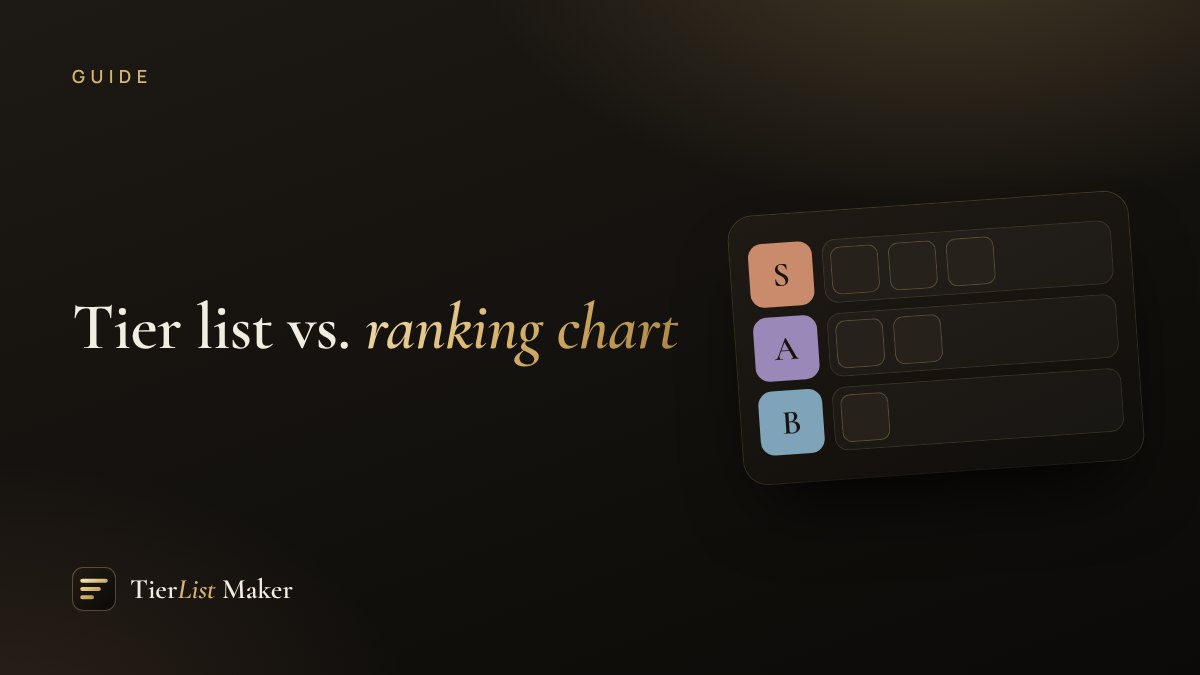
Both formats put things in order, but they answer different questions. A ranking chart (or top 10 list) says exactly where each item sits. A tier list says which items belong together.
Ranking charts: precise order
A ranking gives every item its own position. That’s ideal when:
- the differences are clear or measurable;
- one winner matters (“the best film of the year”);
- the list is short — usually 3 to 25 items.
The downside is false precision. Is your 6th favourite album really better than your 7th? A ranking forces you to decide anyway. Build one with the ranking chart maker.
Tier lists: honest groupings
A tier list groups items of similar quality. That’s ideal when:
- opinions are subjective and ties are natural;
- you’re comparing a lot of items (20+);
- you want to start a discussion, not end one.
The downside is less precision at the top. Fix that by ordering items inside each tier — leftmost is best. Make one with the tier list maker.
Side by side
| Tier list | Ranking chart | |
|---|---|---|
| Ties allowed | Yes | No |
| Best for | Many items, subjective topics | Short lists, clear winners |
| Speed | Fast | Slower |
| Typical size | 15–50 items | 3–25 items |
| Starts debates | Constantly | Sometimes |
Use both
A great workflow: rough out a big tier list first, then take your S tier and rank it precisely in a ranking chart. You get the speed of tiers and the drama of a definitive number one.
Quick decision guide
- “These three are basically equal” → tier list.
- “I need one clear winner” → ranking chart.
- “I have 40 items and an hour” → tier list.
- “Top 5 for a social post” → ranking chart.
New to tiers? Start with what a tier list is and what S tier means.
Try it yourself
Free, no sign-up — rank anything in minutes.