
Guide
What is a tier list?
The meaning of a tier list, where the format came from, and why it took over the internet.
Updated
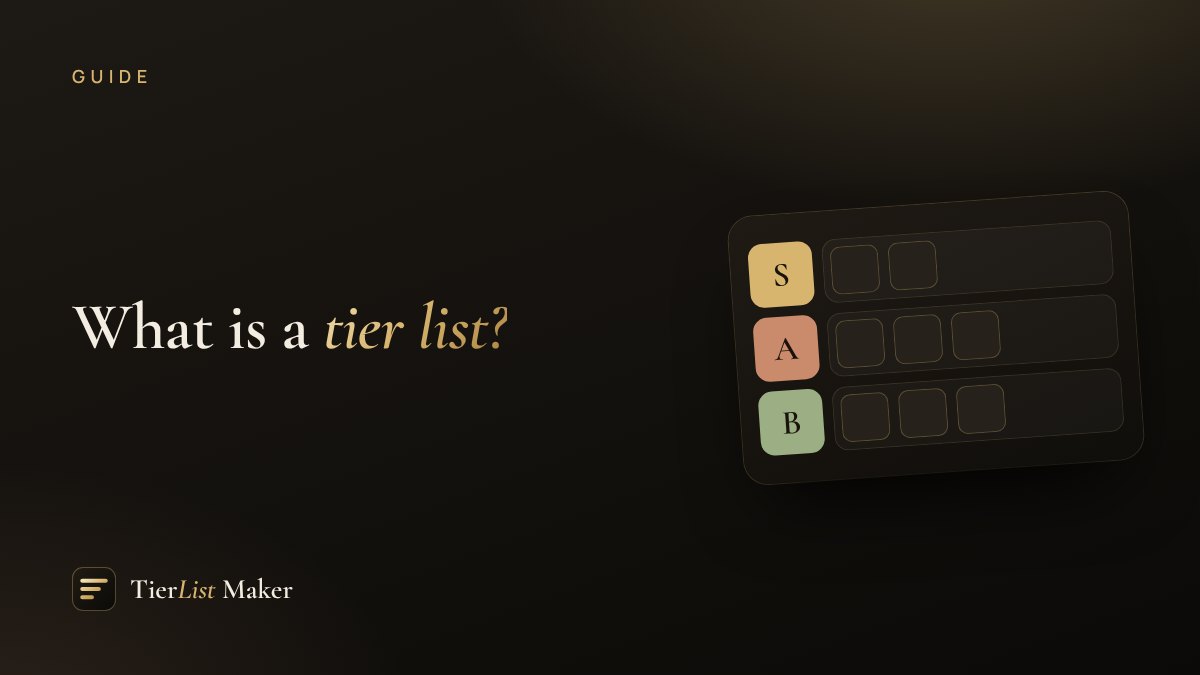
A tier list is a way of ranking things by sorting them into labelled groups — called tiers — from best to worst. Instead of giving every item an exact position like a top 10 list, a tier list says “these belong together”. Two films can both be A tier without anyone having to decide which is 4th and which is 5th.
The tier list meaning, in one sentence
A tier list is a visual ranking where each row is a level of quality, and every item is dropped into the row it deserves.
How a tier list works
- Pick a topic — anything you have opinions about: games, foods, films, cities.
- Gather the items you want to compare.
- Sort them into tiers. The classic scale is S, A, B, C, D and F, with S at the top.
- Order items inside each tier (optional) — the leftmost item is the strongest.
- Share it and let the discussion begin.
You can make one in seconds with our free tier list maker, or start from one of our ready-made templates.
Where tier lists came from
The format grew up in competitive gaming communities in the late 1990s and 2000s. Fighting-game players grouped characters by tournament strength — “top tier”, “mid tier”, “low tier” — and posted the lists on forums for debate. The S tier above A was borrowed from the S ranks awarded in many Japanese video games, and the familiar S-to-F scale was born. You can read more in our guide to what S tier means.
In the 2010s, image templates and dedicated websites made the format easy for anyone to use, and tier lists spread far beyond games: food, music, movies, school subjects, even days of the week.
Why tier lists are so popular
- They’re fast. Grouping is easier than strict ordering, so you can rank 30 items in a few minutes.
- They’re honest. Real opinions often have ties; tiers allow them.
- They’re visual. A finished board is readable at a glance and easy to share.
- They start conversations. Everyone disagrees with at least one placement — and that’s the fun.
Tier list vs. ranking list
A ranking (or top 10) gives every item a unique position. A tier list groups similar items. Use a tier list for subjective topics with lots of items; use a ranking when one definitive order matters. Our guide on tier lists vs. top 10 lists goes deeper, and the ranking chart maker handles strict orders.
Make your first tier list
Ready to try? Open the tier list maker, choose a template or start blank, and drag your first item into S tier.
Try it yourself
Free, no sign-up — rank anything in minutes.